How do Indian laws penalise racial discrimination against northeastern citizens?
India uses criminal codes, cyber laws, and targeted statutes to penalise racial abuse against northeastern citizens, though advocates call for an explicit anti-racism law.
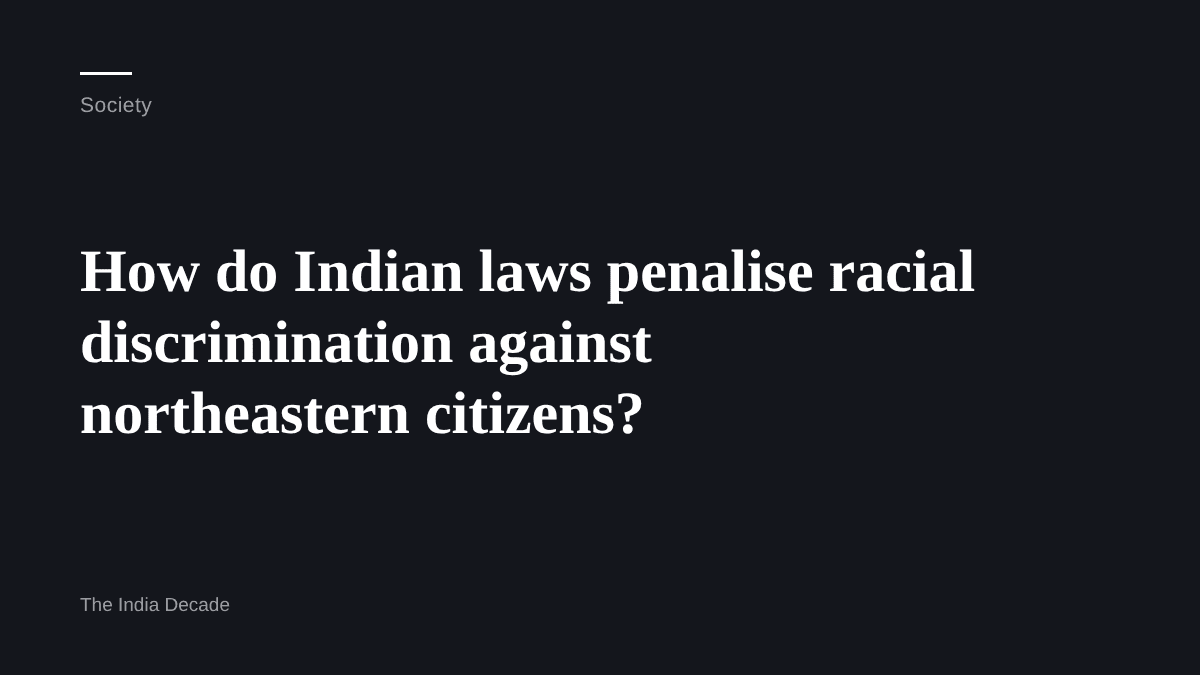
Indian law does not contain a single comprehensive statute defining or prohibiting racial discrimination, but it penalises racial abuse and harassment through multiple provisions of the Bharatiya Nyaya Sanhita and the Information Technology Act, 2000. When victims belong to recognised indigenous communities, offences are prosecuted under the Scheduled Castes and Scheduled Tribes (Prevention of Atrocities) Act, 1989, which carries stricter, non-bailable penalties. Specialised police units like Delhi Police's Special Police Unit for North East Region handle enforcement in major metropolitan hubs. However, community leaders and human rights advocates continue to demand dedicated federal anti-racism legislation as recommended by government committees.
- Bharatiya Nyaya Sanhita, IT Act 2000, and SC/ST Atrocities Act
- Ministry of Home Affairs, October 2026
- Racial abuse video recorded 19 September 2026
- Youth Tipra Federation complaint, October 2026
- 24-year-old student killed in Dehradun in December 2025
- Tripura Congress Legislature Party letter, October 2026
- Delhi Police SPUNER helpline 1093
- Delhi Police, October 2026
- Bezbaruah Committee proposed explicit penal amendments in 2014
- Ministry of Home Affairs, 2014
What's happening now
In October 2026, public outrage erupted across Northeast India after a video recorded in Delhi on 19 September 2026 went viral on social media. The video showed Delhi-based content creator Amir Shokeen directing racial slurs—including calling a young man from Tripura "Chinese" and "chinky"—distorting the name of Tripura into an obscene expression, and inappropriately touching him for digital content.
On 21 October 2026, the Youth Tipra Federation lodged a formal complaint at the New Capital Complex Police Station in Agartala, demanding action under the Bharatiya Nyaya Sanhita and the Information Technology Act, 2000. Senior political figures joined the condemnation: Union Minister Kiren Rijiju warned that the creator would face strict punitive action, Tripura Chief Minister Manik Saha instructed state police to coordinate directly with Delhi Police, and Tripura Congress Legislature Party leader Birajit Sinha urged the state government to safeguard the constitutional dignity of northeastern citizens.
Shokeen published a social media video offering an apology, claiming the interaction was a lighthearted exchange between former work colleagues. Indigenous student bodies and political leaders rejected the explanation. They emphasised that treating racial abuse as entertainment reinforces systematic prejudice against northeastern residents in mainland metropolitan centers, citing the December 2025 killing of 24-year-old Tripura MBA student Anjel Chakma in Dehradun following racial taunts.
How legal action against racial abuse is pursued under Indian law
Filing an initial police complaint
A victim or representative organisation files a First Information Report or formal complaint at any local police station or digital cybercrime portal. Under Zero-FIR rules, police must record the complaint regardless of where the incident occurred and transfer it to the jurisdiction responsible.
Invoking Bharatiya Nyaya Sanhita charges
Investigators apply provisions under the Bharatiya Nyaya Sanhita covering intentional insult to provoke breach of peace, public mischief, assault, and outraging modesty. Police evaluate whether spoken slurs, derogatory comparisons, or unwanted physical contact meet the standard for criminal intimidation.
Applying the SC/ST Atrocities Act
If the victim belongs to a officially recognised Scheduled Tribe, police invoke the Scheduled Castes and Scheduled Tribes (Prevention of Atrocities) Act, 1989. Offences under this statute are non-bailable and impose strict statutory penalties for intentional public humiliation.
Applying cybercrime statutes
When racial harassment is recorded, uploaded, or shared online, charges under the Information Technology Act, 2000 are added. Authorities liaise with social media platforms to preserve digital evidence, remove content, and trace electronic signatures.
Inter-state police coordination
State police forces collaborate with metropolitan departments, such as the Special Police Unit for North East Region in Delhi, to execute arrest warrants. The case then proceeds to court where prosecutors submit digital recordings and witness statements.
Who it affects
Estimates from migration studies indicate that hundreds of thousands of students and workers from the eight northeastern states reside in mainland Indian cities, with significant populations in Delhi National Capital Region, Bengaluru, Mumbai, and Pune.
Surveys conducted by civil society organisations reveal that a high proportion of northeastern migrants report experiencing racial slurs, rental housing refusal, or physical harassment while living in mainland cities. Indigenous individuals, who often possess distinct facial features and cultural identities, face heightened risk of targeted racial profiling and derogatory slurs such as "chinky" or assumptions of foreign origin.
What's being done, and is it working
Institution
Delhi Police
Operates the Special Police Unit for North East Region (SPUNER) and a dedicated 1093 helpline to respond to racial harassment and crimes against northeastern residents.
Community
Youth Tipra Federation
Filed formal police complaints in Agartala to force inter-state police action and prosecution against social media creators broadcasting racial slurs.
Institution
Ministry of Home Affairs (Bezbaruah Committee)
Constituted an expert committee in 2014 which recommended introducing explicit provisions into the penal code to punish racial discrimination.
Institution
Tripura State Government
Directed state police leaders to coordinate directly with Delhi Police and central agencies to prosecute out-of-state racial offenders.
What you can do
Report immediate racial harassment or safety threats in Delhi to the Special Police Unit for North East Region on helpline 1093.
File a complaint on the National Cyber Crime Reporting Portal if racial abuse or slurs are circulated online.
Preserve electronic evidence by saving video files, taking screenshots, and recording original profile URLs before reporting online abuse.
Contact state legal services authorities or verified northeastern student welfare associations for legal representation.
Insist on registering a Zero FIR at the nearest police station if an offence occurs outside your local jurisdiction.
What we still don't know
- Will Parliament introduce dedicated anti-racism legislation that explicitly defines and penalises racial slurs as distinct criminal offences?
- How effectively can state police agencies coordinate cybercrime prosecutions across different state jurisdictions?
- Will social media platforms enforce automated moderation standards to detect and remove racial slurs targeting northeastern communities?
Questions readers ask
Is there a specific anti-racism law in India?
India does not have a single dedicated law named an anti-racism act. Racial harassment and slurs are prosecuted using general penal provisions under the Bharatiya Nyaya Sanhita, cybercrime statutes, and the SC/ST Atrocities Act.
What is the legal penalty for using racial slurs in India?
Using racial slurs in public can trigger charges under the Bharatiya Nyaya Sanhita for intentional insult and public mischief. If the victim belongs to a Scheduled Tribe, charges under the SC/ST Atrocities Act carry non-bailable terms and imprisonment of up to five years.
What was the Bezbaruah Committee?
The Bezbaruah Committee was appointed by the Ministry of Home Affairs in 2014 to examine concerns of northeastern citizens in mainland cities. It recommended strict amendments to the penal code to punish racial slurs and advocated specialised police units.