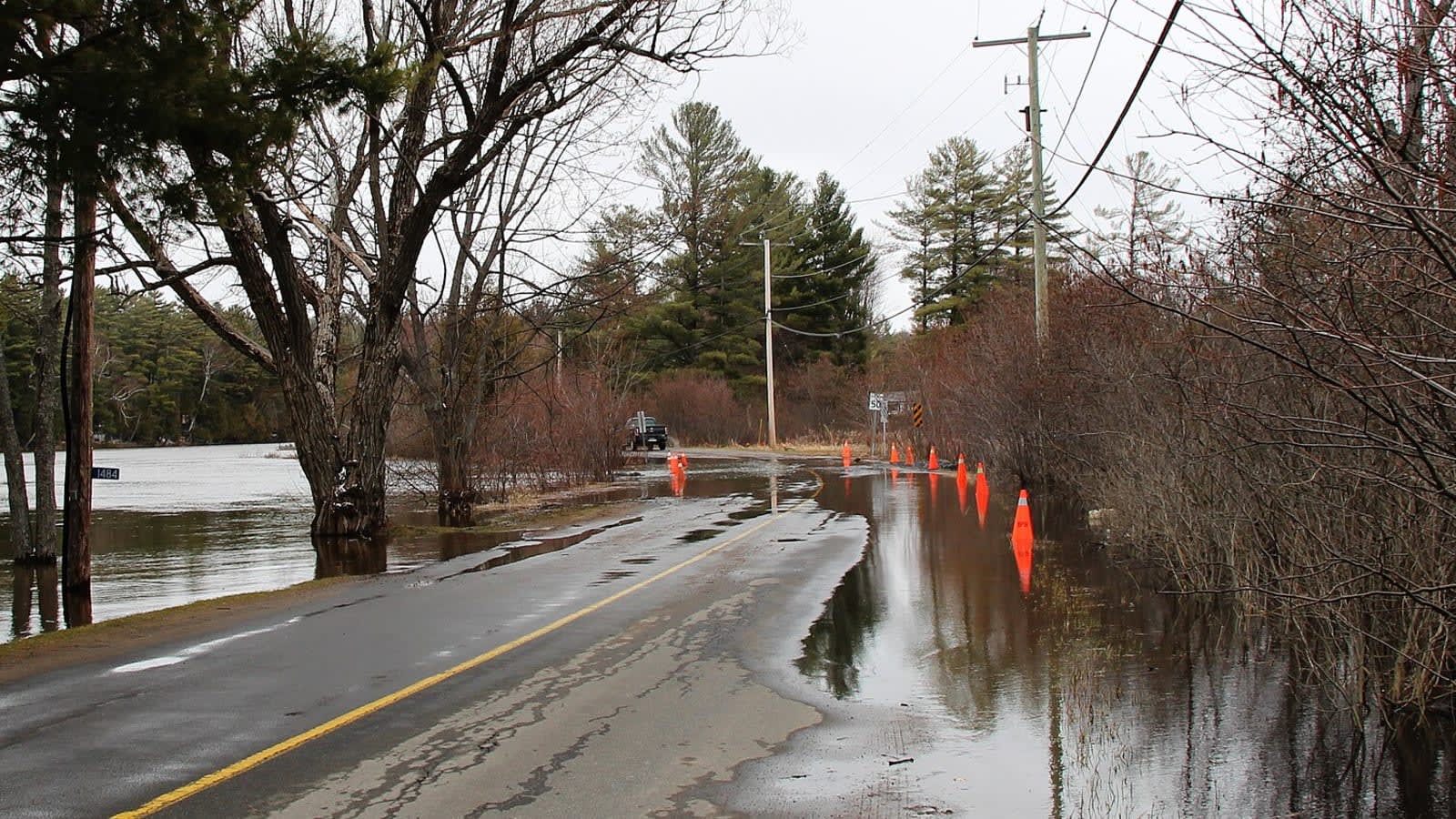
Why a one-in-a-hundred-year flood can happen two years in a row
The probability language used to describe flood risk is giving communities a false sense of security, just as climate change rewrites the rules.

The phrase "one-in-a-hundred-year flood" sounds like a promise. It conjures up the image of a cosmic clock resetting after a disaster, offering ninety-nine years of guaranteed dry safety.
If your home was inundated last winter, you might naturally assume you have earned a lifetime of immunity. But you have not. The term is widely misunderstood, and that misunderstanding is leaving communities exposed as the climate shifts.
What the numbers actually mean
To a hydrologist or a civil engineer, a "one-in-a-hundred-year flood" has nothing to do with time. It is a statement of probability.
It refers to an event that has a 1% chance of occurring in any single year.
Think of it like rolling a 100-sided die. If you roll a one this year, the odds of rolling a one next year remain exactly the same: 1 in 100. The river does not remember last year's flood.
This means that over a standard 30-year mortgage, a home built in a "one-in-a-hundred-year" floodplain has a much higher risk of flooding than most homeowners realise. The cumulative probability of being flooded at least once during those three decades is about 26%.
How we build our defences
Local planners and engineers use these statistical thresholds to decide where it is safe to build houses and how high to build protective barriers.
In the UK, flood defences for urban areas are frequently designed to withstand a 1-in-100-year flood. Engineers typically add an extra margin of safety, known as "freeboard", to account for waves and turbulence. For agricultural land, the standard of protection is lower, often designed to defend only against smaller, more frequent 1-in-10 or 1-in-25-year events.
But calculating these thresholds is incredibly difficult. To know what a 100-year flood looks like, you ideally need centuries of reliable river flow data. In reality, most river gauge records in Britain only go back 50 or 60 years. Engineers are forced to extrapolate, using mathematical models to estimate the size of a flood they have never actually seen.
The end of a stationary climate
This guesswork has worked well enough in the past, but it relies on a fundamental assumption: that the future will look like the past. In hydrology, this is called "stationarity"—the idea that while weather fluctuates, the long-term averages remain constant.
That assumption is no longer true. As rising global temperatures allow the atmosphere to hold more water, storm patterns are shifting. Extreme rainfall is becoming heavier and more frequent.
What was recorded as a 1-in-100-year flood in the twentieth century might now be a 1-in-50-year or even a 1-in-20-year event. The historical records used to design existing concrete walls and bypass channels are increasingly out of date.
What happens next?
Some agencies are moving away from the "one-in-a-hundred" language entirely, preferring to talk about "annual exceedance probability" to avoid confusing the public.
At the same time, design standards are being adjusted. In the UK, the Environment Agency applies "climate change allowances"—percentage increases added to peak river flow estimates to account for future warming.
But because the climate is changing faster than infrastructure can be built, communities are left playing a game of chance where the rules, and the dice, are constantly changing.
Key numbers
- 26%
- 50 to 60 years