Fast radio burst from 10 billion years ago is the most distant ever detected
The flash of energy travelled through 80 per cent of cosmic history before hitting telescopes on Earth.
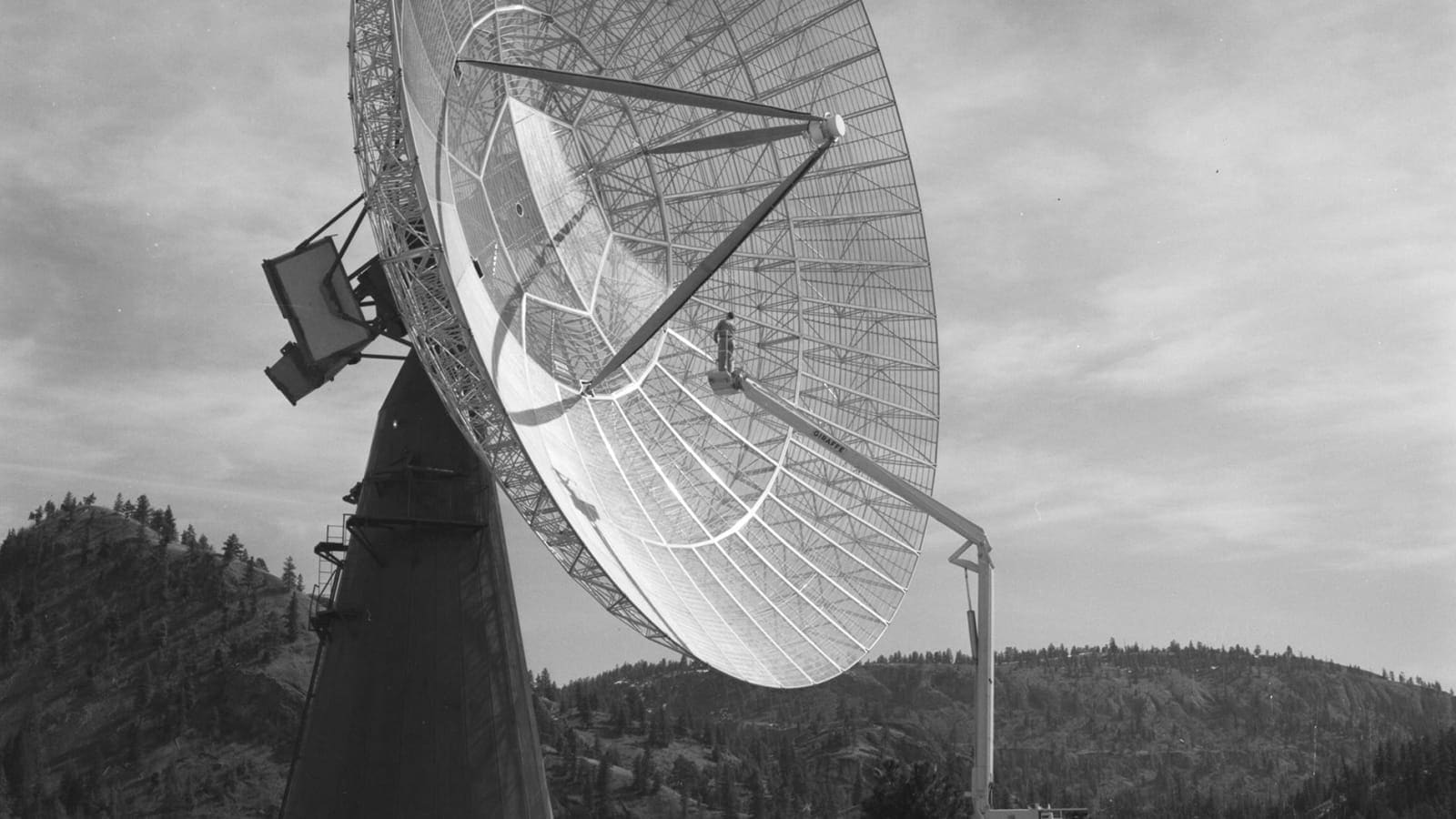
Astronomers have detected the most distant fast radio burst ever recorded, a mysterious flash of cosmic energy that travelled for more than 10 billion years before reaching Earth.
The signal, named FRB 20240304B, originated when the universe was only about three billion years old. Having travelled through roughly 80 per cent of cosmic history, the burst has more than doubled the previous distance record for such detections.
An international team of scientists first picked up the burst using the MeerKAT radio telescope in South Africa. They then used NASA’s James Webb Space Telescope to track the signal back to its source: a tiny, young galaxy that is forming stars at an extremely high rate, but contains very few metals.
"When this was produced, there was no Earth, there was no sun," said Dr Themiya Nanayakkara, a lead researcher on the study from the University of Sydney.
Fast radio bursts, or FRBs, are intense pulses of radio waves. Though they last only a few milliseconds, they can discharge as much energy in that fraction of a second as our sun does over several months or even years. Since they were first discovered in 2007, astronomers have logged more than 10,000 of them, but their origins remain one of space science's great mysteries.
While some scientists once speculated about alien origins, the leading theory is that they are produced by magnetars — highly dense neutron stars with incredibly strong magnetic fields. However, the host galaxy of this new burst complicates things. Dr Nanayakkara pointed out that whatever physical process causes these bursts must be able to occur in young, metal-poor environments.
It remains unclear whether FRB 20240304B is a single, isolated event or if it will fire again. Some FRBs are one-off flashes, some repeat for a while and stop, and others recur regularly.
For astrophysicists, however, the signal is useful regardless of what created it. Because radio waves interact with the gas and dust they pass through, researchers can use them to measure cosmic matter that optical telescopes cannot see.
Professor Matthew Bailes of Swinburne University, one of the co-discoverers of FRBs, said the finding is a validation of how powerful these bursts are for probing the cosmos. He described them as "a very fundamental way of counting how many atoms there are in the universe."
Dr Sara Webb, an astrophysicist at Swinburne University who was not involved in the research, said the signal essentially provides a "line-of-sight count" of the material it had to pass through to get to Earth. The discovery, she added, suggests these energetic bursts may have been highly common in the early universe.
Key numbers
| What | Figure | Source |
|---|---|---|
| Travel time of the radio burst | More than 10 billion years | The study published in Science |
| Age of the universe when the burst originated | About 3 billion years | The study published in Science |
| Total FRBs detected since 2007 | More than 10,000 | Dr Themiya Nanayakkara |
In this story
| Name | Role in the story |
|---|---|
| Dr Themiya Nanayakkara | Lead researcher on the paper from the University of Sydney. |