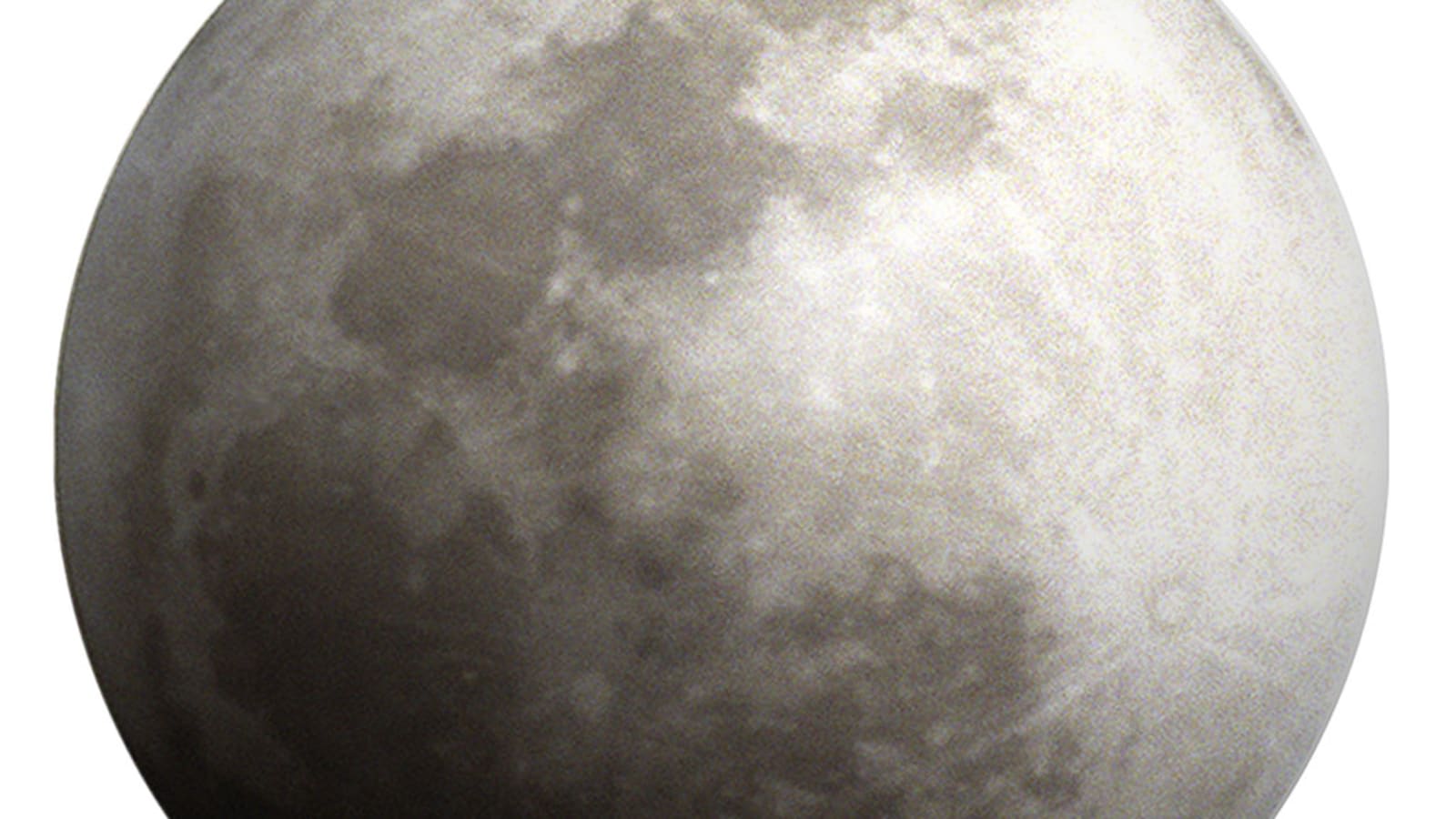
The Moon may have formed in just five hours, new study suggests
By factoring in the physical strength of the early Earth and its collider, scientists have shown the Moon could have emerged intact in a single afternoon.
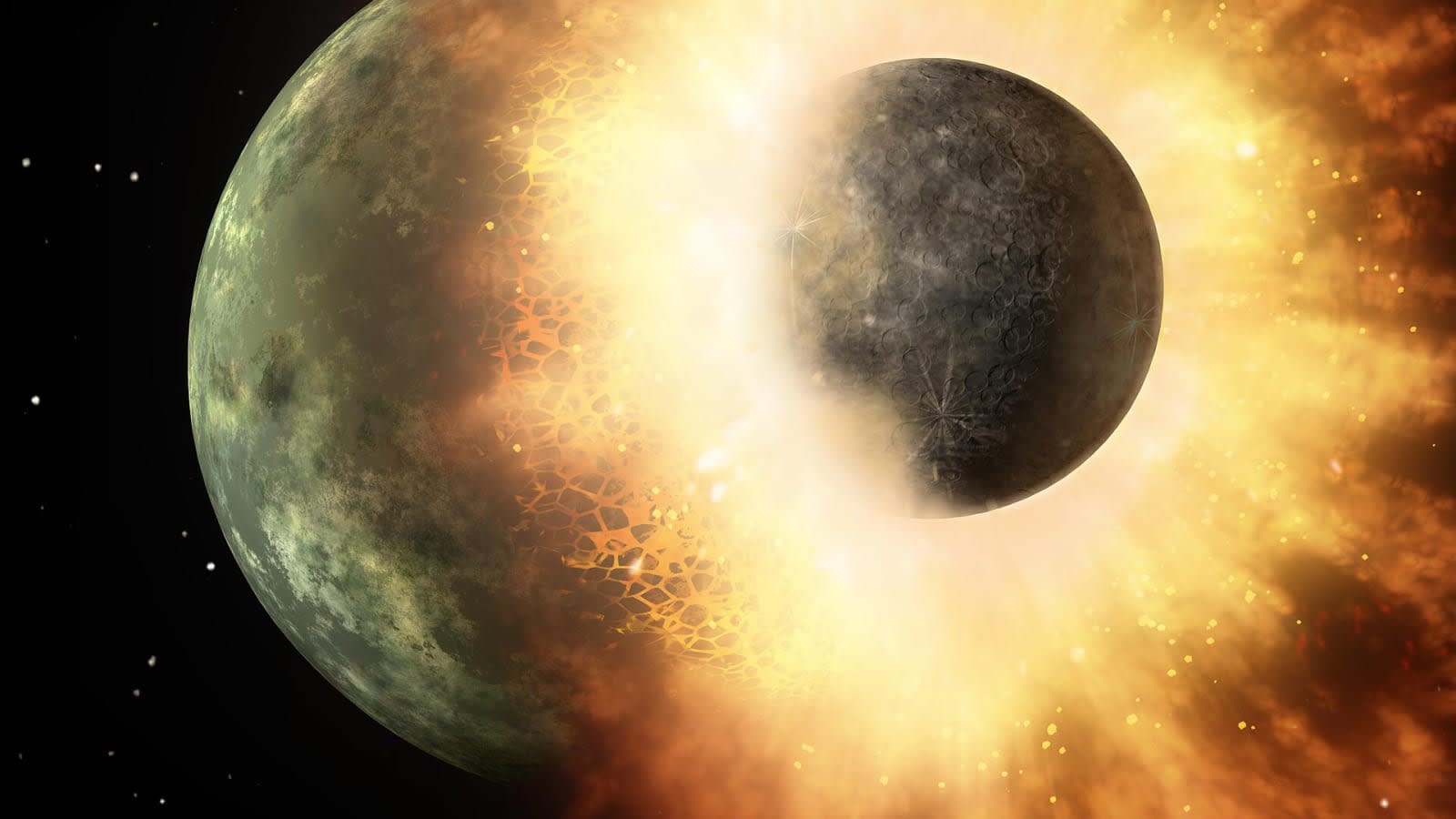
The Moon may have formed in a matter of hours, rather than over years of slow accumulation, according to new simulations of the giant planetary collision that created it.
The study, published in The Astrophysical Journal Letters, suggests that a long-overlooked factor—the physical strength and temperature of the colliding worlds—fundamentally changes our understanding of the Moon's birth.
For decades, the leading explanation for our Moon's origin has been the giant impact theory. Scientists believe that a Mars-sized planet named Theia slammed into the early Earth about 4.5 billion years ago. In standard models, the collision was thought to be so energetic that both bodies melted, creating a vast disk of debris that gradually came together over a long period to form the Moon.
But those earlier models, including a landmark 2001 study led by Robin Canup and Erik Asphaug, treated the colliding planets as simple fluids.
To test whether that assumption held up, a research team from the Southwest Research Institute and the University of Arizona decided to factor in realistic geology. Using an advanced form of smoothed particle hydrodynamics (SPH)—developed at the University of Arizona and the University of Bern—the team ran simulations that accounted for how real rocks and metals resist deformation.
"We discovered that the preexisting geology of the Mars-sized proto-moon matters," said Adeene Denton, a former postdoctoral researcher at the Lunar and Planetary Laboratory who is now at the Southwest Research Institute. "When you simulate the Earth and the Moon as colliding bodies with geologic properties, it changes how the Moon forms."
The temperature of the protoplanets at the time of the impact turned out to be especially important. Hotter planetary bodies are mechanically weaker than colder ones. When the researchers ran the simulations with colder, structurally stronger bodies, they got a dramatic result: instead of scattering into a broad ring of debris, a fully intact Moon emerged from the wreckage in just five hours.
This instant-formation model could help researchers solve other mysteries, such as pinning down exactly when the collision occurred. Canup, who was not involved in the new study, noted that these results connect the physical properties of the Moon today with the thermal state of the Earth and Theia at the time of the impact.
However, one major puzzle remains. The Moon and Earth have almost identical chemical compositions, which is highly unusual for two separate bodies in the solar system. The new simulations do not resolve this. "The Moon and Earth are more like fraternal twins," Denton said, noting that Mars, by contrast, has a completely different composition despite forming in the same cosmic neighbourhood.
While scientists are still piecing together how the Moon got there, our history of exploring its surface shows just how difficult it can be to study. In November 1970, the Soviet Union landed its 1,650-pound Lunokhod 1 rover in Mare Imbrium. The eight-wheeled vehicle drove 10.54 kilometres over 11 lunar days before scientists lost contact in the autumn of 1971.
Because early tracking technology was imprecise, the exact location of the rover remained a mystery for nearly 40 years. It was only in 2010, when NASA's Lunar Reconnaissance Orbiter captured images of the rover's tracks, that physicists were able to pinpoint its coordinates and bounce laser signals off its French-built reflector.
As space agencies prepare for a much busier lunar environment this decade, the challenges of tracking hardware—and understanding the ancient geology beneath it—remain as relevant as ever.
Key numbers
- 5 hours
- 4.5 billion years
- 10.54 kilometres